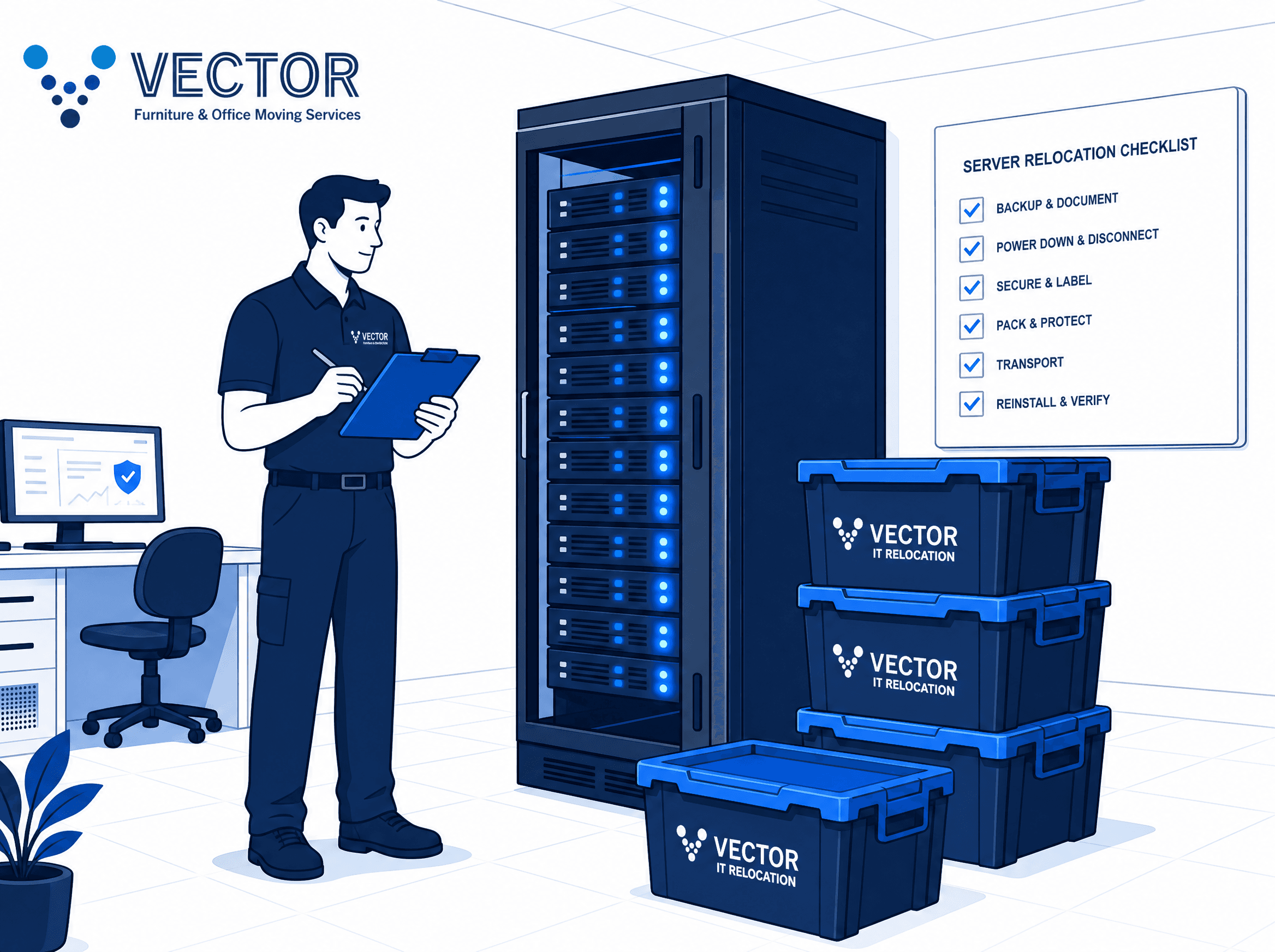
A data center or server room relocation is a coordinated technology, facilities, and logistics project. The physical move is only one part of the work. IT leaders also need an accurate asset inventory, an approved shutdown sequence, chain-of-custody controls, building access, transport protection, and a tested recovery plan.
Vector Installation Services supports the physical logistics around server room moves in Southern California. Your IT team or managed service provider remains responsible for backups, application shutdowns, data migration, network configuration, and system validation unless those responsibilities are explicitly assigned to a qualified technology vendor.
What should a server room relocation plan include?
A complete plan should identify every asset, its owner, its rack position, its cabling dependencies, its shutdown order, its destination, and the person responsible for validating it after reconnection.
At minimum, document:
- Servers, storage arrays, switches, firewalls, UPS units, racks, and peripherals.
- Serial numbers, asset tags, rack units, cable labels, and destination positions.
- Required maintenance windows and approved outage communications.
- Backup confirmation and rollback criteria.
- Disconnect, packing, transport, reconnect, and validation owners.
- Loading access, elevator reservations, security escorts, and insurance requirements.
- Escalation contacts for facilities, networking, applications, vendors, and leadership.
Build the inventory before setting the move sequence
Do not build a schedule from a room count alone. Start with a verified asset list and a rack elevation for the current and destination rooms. Photograph rack fronts, rack backs, patch panels, cable paths, and equipment labels before anything is disconnected.
Each asset should receive a move identifier that stays with it through packing, transport, staging, and final placement. Matching labels on equipment, protective packaging, and the destination rack reduce guesswork during reconnect.
Assign responsibilities clearly
| Workstream | Typical owner |
|---|---|
| Backups and application shutdown | Internal IT or managed service provider |
| Network diagrams and cable maps | Network team |
| Rack, equipment, and pathway measurements | IT and facilities |
| Building access and freight coordination | Facilities or property management |
| Physical packing and protected transport | Qualified relocation team |
| Reconnection and configuration | IT or technology vendor |
| Application and user acceptance testing | System owners |
Use a written responsibility matrix. Ambiguous ownership is one of the fastest ways to lose time during a maintenance window.
Protect chain of custody
Sensitive equipment should not move as anonymous cartons. Record when each labeled asset leaves the rack, who receives it for transport, when it reaches the destination, and when it is handed back to the technical owner.
Use anti-static materials where appropriate, protective rack or equipment cases, tamper-evident seals for sensitive assets, and enclosed vehicles with controlled access. Drives and other data-bearing devices should follow the security requirements established by your organization.
Plan the shutdown and recovery sequence
The shutdown plan should follow application dependencies, not just rack order. Confirm backups before the maintenance window and document the conditions that would trigger a rollback.
At the destination, validate facilities before equipment arrives:
- Power circuits and UPS capacity are active.
- Cooling is operating at the required level.
- Racks are secured and correctly positioned.
- Network circuits and patching are ready.
- Clearances and service access are maintained.
- The room is clean, dry, secure, and free of construction activity.
Reconnect infrastructure in the order defined by the IT recovery plan. Record exceptions instead of improvising undocumented changes.
Day-of relocation checklist
- Hold a final go or no-go call with IT, facilities, and the move lead.
- Confirm backups, maintenance notices, access credentials, and escalation contacts.
- Photograph and verify the current rack state.
- Shut down systems according to the approved dependency sequence.
- Label, disconnect, protect, and log each asset.
- Reconcile the outbound inventory before the vehicle leaves.
- Reconcile the inbound inventory at the destination.
- Place equipment according to the destination rack elevation.
- Hand assets to the technical team for reconnection and validation.
- Record test results, exceptions, and final acceptance.
How Vector supports technology relocations
Vector can coordinate the physical work surrounding a technology move, including walkthroughs, building logistics, equipment protection, labeled transport, rack placement, and coordination with your IT provider. Related services include IT disconnect and reconnect coordination, structured cabling, and multi-vendor project management.
Planning a server room relocation in Southern California? Request a project walkthrough so the physical scope, access requirements, responsibilities, and schedule can be documented before the maintenance window.