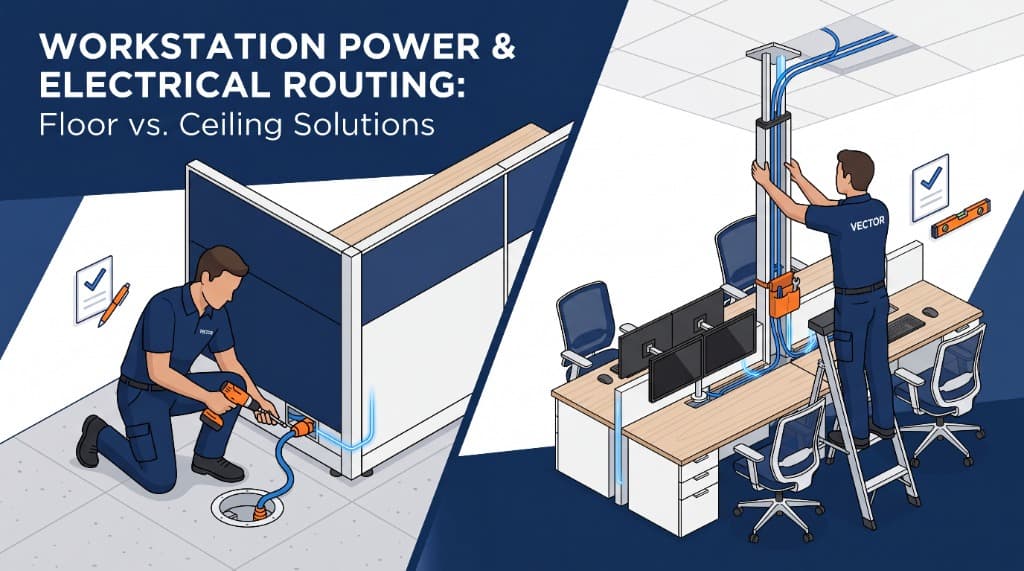
Quick Comparison
Base Power Infeeds (BPI) provide a clean, invisible connection from concrete floor cores or wall boxes into bottom panel raceways. Power Poles (Ceiling Drops) drop utility feeds from the ceiling grid down an aluminum conduit, eliminating concrete core drilling in post-tension slabs and lease-restricted spaces.
Vector Installation Services coordinates cubicle installation, structured cabling, and office furniture installation with general contractors and commercial electricians across Southern California.
The Challenge of Workstation Electrical & Data Distribution
When designing an open-office layout with systems furniture (such as Herman Miller, Steelcase, Haworth, Knoll, or AIS), one of the earliest decisions facility managers face is how to deliver building power and data to freestanding cubicle clusters.
Unlike standard residential desks that simply plug into a wall outlet, commercial workstation clusters require dedicated multi-circuit electrical whips that integrate directly into the furniture's internal power blocks. Choosing the wrong infeed strategy can lead to core-drilling delays, X-ray scanning costs, or unsightly ceiling clutter.
Side-by-Side Comparison: Base Power Infeed vs. Power Pole
| Feature | Base Power Infeed (BPI) | Power Pole (Ceiling Feed) |
|---|---|---|
| Power Entry Point | Floor core, monument box, or perimeter wall. | Plenum ceiling drop down vertical pole. |
| Visual Impact | Clean & invisible; cables concealed inside base raceway. | Visible vertical pole extending from desk to ceiling grid. |
| Floor Modification | Requires concrete core drilling, trenching, or poke-throughs. | Zero floor alterations; attaches to ceiling grid T-bar. |
| Post-Tension Slab Safe | Risky; requires GPR X-ray scanning before core drilling. | 100% safe; no floor drilling required. |
| Reconfiguration Ease | Locked to floor core locations; moving pods requires new cores. | Highly flexible; pole moves anywhere along the ceiling grid. |
| Cost Considerations | Higher upfront construction (core drilling + X-ray scan). | Lower upfront installation cost; pole hardware included. |
| Data Capacity | Limited by floor core conduit diameter. | High capacity; dual-channel pole isolates power from Cat6/fiber. |
Deep Dive: Base Power Infeeds (BPI)
A Base Power Infeed (often called a base feed, floor monument whip, or liquid-tight conduit whip) connects the building electrical source to the bottom raceway of a cubicle spine wall.
How Base Infeeds Work
The infeed cable consists of a flexible metal or liquid-tight conduit housing 8 to 10 electrical conductors. One end connects into the modular power block inside the furniture panel, while the open wire pigtail connects into a junction box inside a concrete floor core, poke-through box, or raised access floor.
Advantages of Base Power Infeeds:
- Zero Visual Obstructions: All wiring is completely concealed within the bottom 4 inches of the cubicle panel raceway.
- Preserves Sightlines: Clean architectural aesthetics for open-plan offices with glass walls or high open ceilings.
- Shortest Cable Runs: Power enters directly at the base of the workstation cluster without traveling 10+ feet down from the ceiling.
Limitations to Consider:
- Requires Pre-Existing Floor Cores: If cores are missing, concrete drilling and GPR (Ground Penetrating Radar) scanning are required.
- Post-Tension Slab Restrictions: Drilling into post-tension concrete slabs carries severe structural risk and is often prohibited by commercial building managers.
- Layout Inflexibility: When you perform an office furniture reconfiguration, pods are locked to existing floor core locations unless new cores are drilled.
Deep Dive: Power Poles (Ceiling Utility Drops)
A power pole (also known as a utility pole or service column) is a vertical aluminum extrusion extending from the top of the cubicle panel up into the drop ceiling grid.
How Power Poles Work
The pole features dual internal channels: one dedicated to high-voltage electrical conductors and a shielded second channel dedicated to low-voltage Cat6/Cat6A data and fiber optic cabling. It attaches securely to the ceiling T-bar grid and fastens rigidly to the cubicle panel frame.
Advantages of Power Poles:
- Zero Floor Modifications: Perfect for leased spaces where core drilling is disallowed or tenant improvement budgets are restricted.
- Ideal for Post-Tension Slabs: Eliminates the need for expensive structural X-rays or scanning.
- Maximum Reconfiguration Flexibility: Workstation pods can be shifted, expanded, or rotated simply by moving the ceiling pole attachment.
- Combined Power and Data: Routes power whips and 24+ network drops simultaneously without cable pinching.
Limitations to Consider:
- Visible Vertical Profile: Poles are visible architectural elements in the open workspace.
- Ceiling Height Requirements: Standard poles support 10-ft to 12-ft ceiling heights; specialized extension brackets are required for open truss or exposed loft ceilings.
Understanding 8-Wire 4-Circuit Modular Wiring Systems
Commercial systems furniture utilizes modular multi-circuit harnesses designed to prevent circuit overload from computers, dual monitors, task lights, and sit-stand desk motors.
The most common configuration is an 8-wire, 4-circuit harness. Understanding the wire schematic ensures your electrician balances the load across panel breakers:
- 3+1 Configuration (3 Shared, 1 Dedicated): 3 hot wires share a common neutral and ground (for general equipment), while 1 hot wire has a dedicated neutral and isolated ground (specifically for sensitive IT servers and desktop hardware).
- 2+2 Configuration (2 Shared, 2 Dedicated): 2 hot wires share one neutral/ground pair, and 2 hot wires share a second isolated neutral/ground pair. Ideal for high-density tech environments.
Step-by-Step Electrical Planning for Workstation Installs
A smooth installation requires tight sequencing between your furniture dealer, installation crew, and electrical contractor:
- Review Architectural Reflected Ceiling & Floor Core Plans: Verify whether power monuments already exist or if electrical must drop from ceiling junction boxes.
- Match Manufacturer Whip Specifications to Building Power: Confirm 8-wire vs. 10-wire systems, 2+2 vs. 3+1 shared neutral configurations, and whip length requirements (typically 6 ft to 12 ft).
- Coordinate Low-Voltage Data Cabling Before Furniture Assembly: Run structured cabling and fiber drops through poles or floor access before locking cubicle panels into place.
- Install Modular Spine Raceways & Snap-In Power Blocks: Certified installers route baseline electrical harnesses, attach duplex receptacles, and level base covers.
- Final Junction Box Termination with Licensed Electrician: Complete building power hookup and perform circuit-by-circuit load and ground testing before staff move-in.
Common Mistakes to Avoid
- Ordering the Wrong Whip Length: Manufacturer standard whips are 6 ft. If your floor box or ceiling junction is offset, order 10 ft or 12 ft whips in advance to prevent emergency change orders.
- Cabling After Furniture Assembly: Never build full cubicle clusters before running baseline data cabling. Follow our guide on structured cabling coordination for best practices.
- Overloading Workstation Circuits: Limit motorized sit-stand desks and desktop hardware to a maximum of 4 workstations per 20-amp circuit.
FAQs About Workstation Power Routing
What is the difference between a base power infeed and a power pole?
A base power infeed (BPI) connects modular cubicle power to building electrical via a floor core, monument box, or wall junction box at the base of the panel. A power pole (ceiling drop) runs electrical and data cabling down from the plenum ceiling inside an aluminum vertical channel directly into the top of the cubicle spine.
When should you use a power pole instead of a base power infeed?
Power poles are ideal when coring concrete floor slabs is prohibited (such as in post-tension slabs), when tenant lease agreements forbid floor modifications, or when floor plans require frequent reconfiguration flexibility without trenching or core drilling.
Can commercial furniture installers connect cubicle power whips?
Furniture installers mount modular harnesses, connect multi-circuit panel jump cables, and position power whips during cubicle assembly. Final electrical terminations into building power junction boxes must be completed by a licensed commercial electrician.
What is an 8-wire 4-circuit modular electrical system?
An 8-wire 4-circuit system is standard commercial systems furniture wiring (e.g., Herman Miller, Steelcase, Haworth). It provides 4 hot wires, 2 or 3 neutrals, and 2 grounds, allowing workstations to distribute power across 4 separate 20-amp circuits to prevent breaker tripping.
Does Vector Installation Services handle workstation power and data routing in Southern California?
Yes. Vector Installation Services coordinates complete systems furniture installation, modular power harness assembly, base infeed routing, power pole installation, and structured cabling integration across Los Angeles, Orange County, and Southern California.
Plan Your Workstation Installation with Vector
Whether your facility requires seamless floor core base infeeds or flexible ceiling power poles, Vector Installation Services provides factory-certified crews equipped to handle complex panel systems, wire routing, and commercial logistics.
We partner with furniture dealers, general contractors, and facility managers across Southern California to ensure your workstations are leveled, wired, and operational on time.
Planning an office buildout?
Ensure your cubicle power and data routing is executed right the first time.
Send us your floor plan and furniture specifications for a detailed, fixed-price installation quote within 48 hours.
Get a Free Quote